Moisture Principles
Water vapor is invisible, has no smell, is sporty and active – so it moves freely around in air, can also pass through wood and bricks and some stone. It likes to rise, defying gravity.
Liquid water is heavier and slower – air cannot carry it and it can only pass though bigger gaps in materials, generally moving downhill with gravity.
Air can carry water vapor, and changing the temperature of the air changes how much water vapor can be carried. Dew point is the temperature at which water vapor turns to liquid and is forced out of the air. Air often cools against cold surfaces like windows and outside walls, which can cause the damp conditions that mould loves.
Sources of Moisture and the Moisture Balance
We produce more moisture at home than will escape by itself – so damp is to be expected unless we actively manage moisture in our homes.
People are usually the biggest source of moisture in the home – breathing 2.5 litres per day per person. Showers = 1 litre per shower. Cooking = 2.5 litres per meal. Fridges and freezers = 0.5 litres a day each. Drying a load of washing on radiators = 1.5 litres per load. Each day all this moisture needs to get out of the house to avoid the house becoming damp.
Tips for Managing Moisture:
- Create Less:
- Put lids on pans
- Wait to open the dishwasher until it has cooled down
- Dry washing outside or in a ventilated room
- Use a squeegee to dry the shower walls after use, so that the water goes down the drain rather than slowly drying into the air
- Use the fasted spin on the washing machine – this gets rid of masses of damp
- Controlling the Moisture:
- Shut the kitchen and bathroom doors to trap moisture in the room
- If you need to dry washing indoors, if possible use one room with some heat on with a window open or extractor fan
- Bring furniture away from walls a little to allow air to circulate, vent wardrobes and built in cupboards
- Removing Moisture
- Use extractor fans – check that fans are venting to the outside, not just the loft
- Open windows to allow the moist air to escape, in the bathroom after a shower and the bedroom once you get up
- Heat the bathroom a bit to reduce the amount of water on the walls – they will dry quicker
Some of the tips above will cost, but in the long term it is worth it….damp homes are bad for our health, bad for the building and its contents, and are more expensive to heat and be comfortable in.
Remember – we produce more moisture at home than will escape by itself – so damp is to be expected unless we actively manage moisture in our homes.
Monitoring Moisture
Moisture is normally measured as relative humidity – a percentage of the potential moisture that the air can carry. 100% means the air is saturated (dew point) and can carry no more, 50% means the air has capacity to carry more water vapor, etc. This can be misleading because the amount of moisture air can carry depends on its temperature. So, cold air at 100% humidity will contain less water molecules than warmer air also measuring 100% humidity.
However, if we know the temperature of the air and its relative humidity, we can find the actual amount of water (actual humidity) in the air. Actual humidity is measured in grams per cubic meter of air. 7 grams per cubic meter is ideal for humans. As homeowners we are interested in two things…how much ‘actual’ water is in the air, and at what temperature will the air reach saturation (100% relative humidity, ie the dew point) where excess water vapor is released as liquid water (like dew).
Moisture Meters
Using a moisture meter helps raise our awareness and motivates us to both produce less and ventilate better.
Room monitor units (‘hygrometers’) are widely available for under £20; they measure relative humidity and temperature. Some monitors record data over a period, historic data can be downloaded or viewed on an app; this is helpful to monitor for trends.
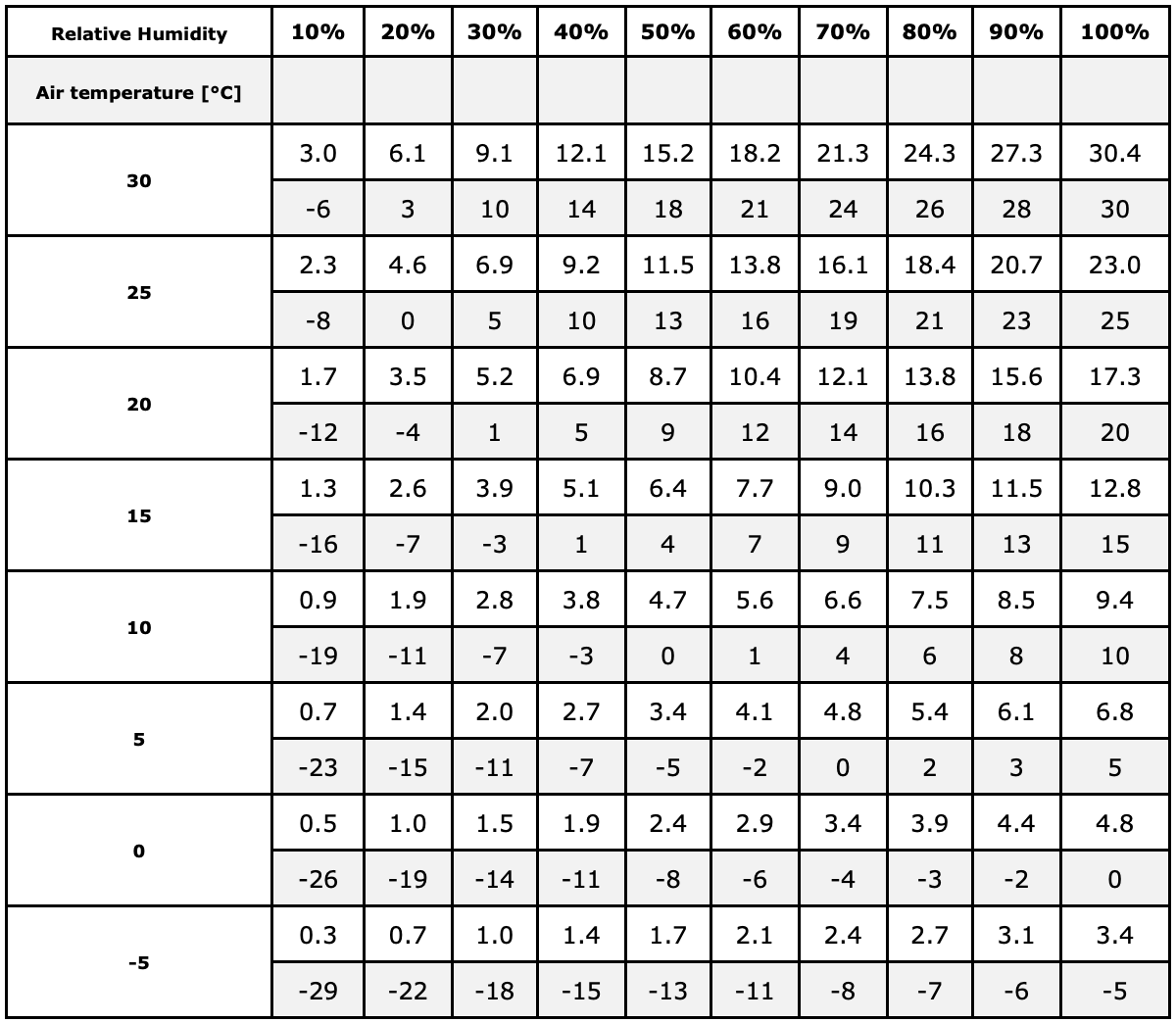
A conversion chart can show actual humidity and the dew point of the air in a room. A room at 20 degrees with relative humidity of 55% has 9.5g of moisture in every cubic meter, and dew point is 10.5 degrees centigrade. So, if the air cools to 10.5 degrees it will reach 100% relative humidity and liquid moisture will start to form on cooler surfaces.
As an example, a bathroom or kitchen whilst in use may reach 25 degrees and 75% humidity, and therefore has 17.5 g of moisture in it. The walls and windows are often cooler than the dew point of 20 degrees, and are wet. Some moisture escapes into the rest of the house and finds the dew point in a cooler, unused room – often against an outside wall behind furniture. It is both these conditions which mold loves. See the Appendix below
Moisture and Walls
Damp walls are a challenge, which again can be managed to a certain extent. Damp walls occur for two main reasons:
- Moisture from the air within the house penetrating the walls and causing damp
- Moisture from maintenance issues, such as blocked drains and gutters
Moisture from Within the House
Older houses built with breathable materials allow moisture vapor to pass through the walls and leave the house. Modern houses on the other hand aim to stop moisture getting into the walls, so moisture must be managed by ventilation. The big challenge for older houses is that many of the retrofit materials commonly used to ‘improve’ houses are non-breathable – this includes cement, many rigid insulation boards and many modern paints. Our houses are generally warmer and consequently the air inside our houses often has more moisture in it. Last month we discovered that 7 grams of moisture per cubic metre of air was ideal, but it is common to find 9-14 grams/m3, increasing moisture vapor travelling through the walls. This additional moisture makes it more likely that the moisture vapor within the wall might reach dew point and therefore turn to liquid. This is exasperated when a house is heated intermittently, or if some rooms are left unheated. Advice is simple:
- Keep moisture levels low in the house by reducing the moisture being created, using a moisture meter and by ventilating well
- Avoid over-heating some areas (this encourages high moisture levels in those areas, which then spreads through the house)
- Heat the home evenly if possible
Moisture from Outside
Walls also become damp if they are in poor condition. For example:
- Broken or blocked gutters cause water to spill down the wall surface or splash from the ground onto the wall.
- Blocked down pipes and soak-aways do similar but also saturate the ground around the base of the wall.
- Often the ground level is higher than when the house was built, covering air vents or reaching the level of floor joists.
- Cement is rigid and waterproof which makes it prone to cracking, especially when it has been used in old buildings over lime mortar and render.
- Poor maintenance of the window frames also provides an ingress point for moisture.
- If there are leaks in pipes within the house, or as they pass through walls. Tiny holes can be almost imperceptible but in winter can create growing damp areas over time.
Good maintenance can prevent or fix the problems above.
Damp walls are cold – liquid water is a very good absorber and conductor of heat, so cold houses may well be transformed simply from drying out. Decisions to insulate are best made after the house is dry. In addition, many of us might find it more comfortable to be in a dry room at 17 degrees centigrade compared with a room at 20 degrees where the walls are damp.
Summary
- Monitor and reduce moisture creation within your home
- Use ventilation to encourage the moisture to escape from the house more easily
- Care for your walls by:
- Heating your home evenly
- Protecting the outside of your house through good maintenance
- Careful choice of materials
Appendix
Actual moisture and dew point table
If room temperature and relative humidity are known, the table below shows actual moisture amounts in grams per cubic meter and in the grey rows the dew point temperature for this quantity of moisture.